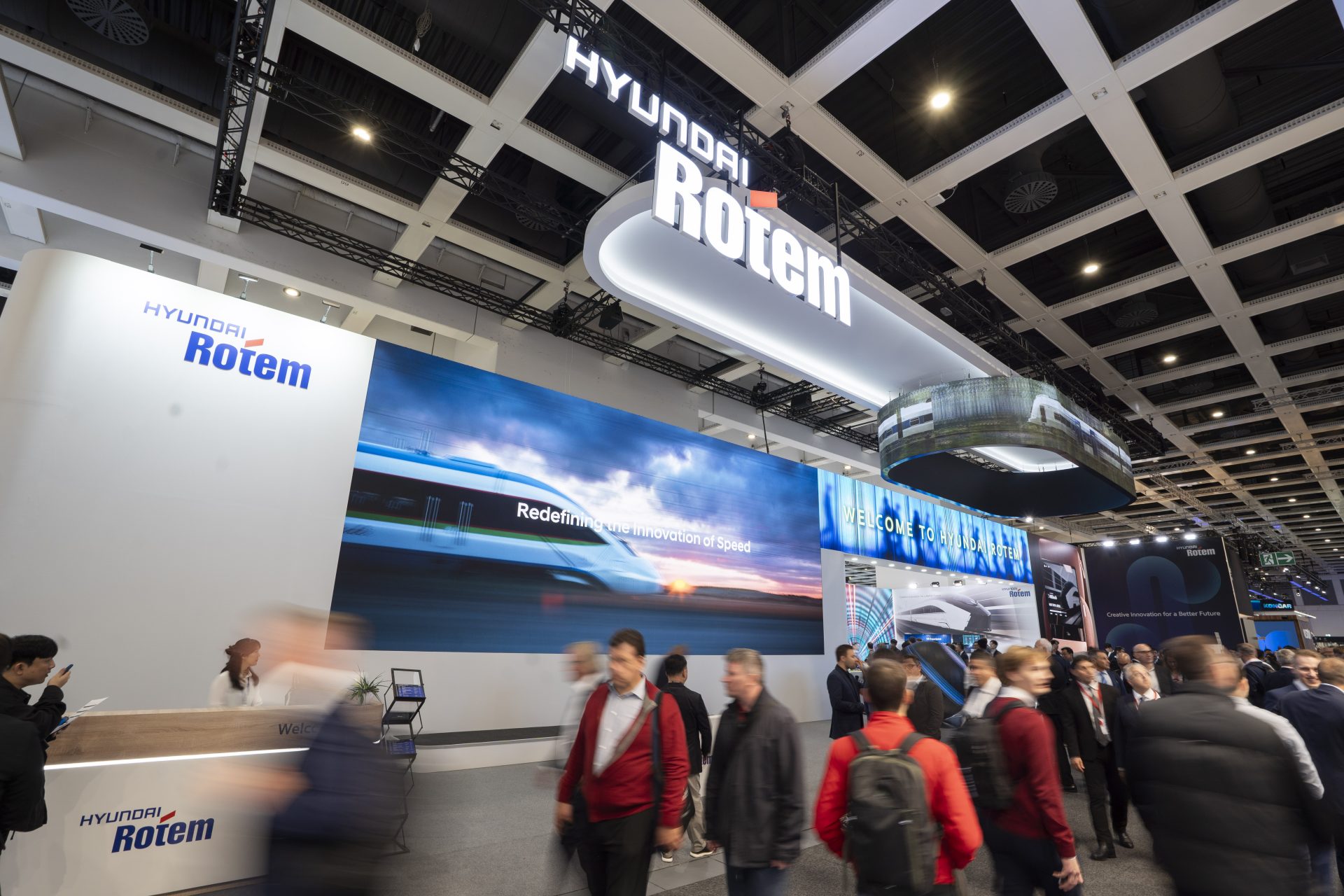
Held from September 22 to 25 (local time) at ExpoCenter City in Berlin, Germany, InnoTrans—which began in 1996—marked its 30th anniversary this year. The exhibition brought together 3,190 participating companies from 59 countries worldwide and welcomed 175,591 visitors from 128 countries.
Hyundai Rotem set up a two-story indoor exhibition pavilion, and in the outdoor display area, it exhibited a full-scale EMU-320 (KTX-Cheongryong) train currently operating in Korea. At the indoor pavilion, the company introduced its next-generation high-speed train alongside AI-based rail solutions, advanced rail technologies, and hydrogen mobility. Spanning from high-speed trains in active service to technologies that will shape future rail systems, the space allowed visitors to explore Hyundai Rotem’s accumulated technological expertise and future development direction all in one place.
400 km/h-Class Next-Generation High-Speed Train: Designing a New Travel Experience Beyond Speed
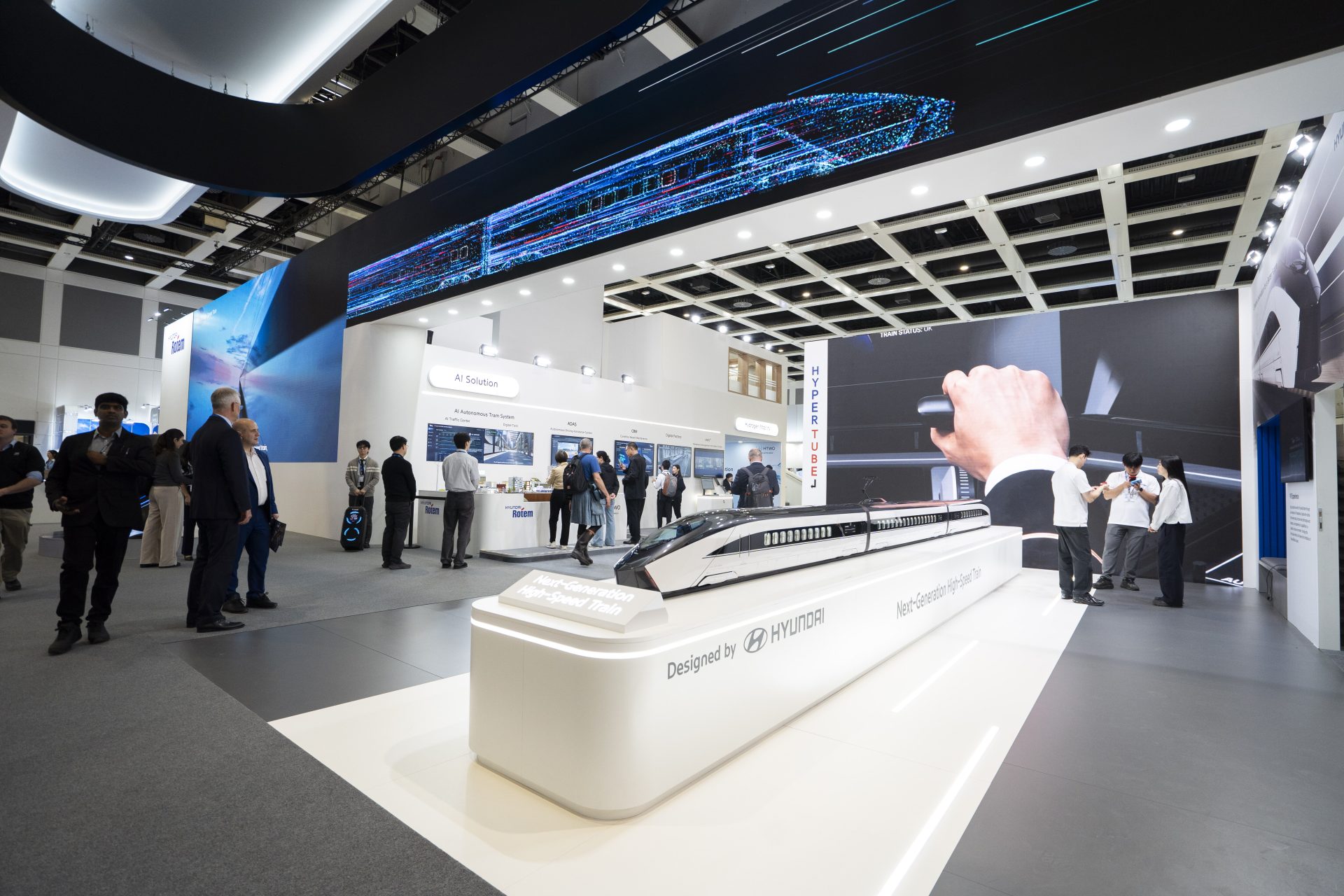
One of the exhibits that captured the spotlight at InnoTrans 2026 was the design of the 400 km/h-class next-generation high-speed train (Next Generation HST). This concept design, developed by Hyundai Rotem in collaboration with the Hyundai Motor Design Center, was unveiled for the first time at the exhibition. With a targeted design speed of 400 km/h and a commercial operating speed of 370 km/h, the next-generation high-speed train was engineered with both aerodynamic performance and the passenger travel experience in mind.
In high-speed trains, design goes far beyond exterior appearance. As speeds increase, aerodynamic drag and pressure waves have a greater impact on vehicle energy efficiency and ride comfort. Considering these high-speed operating conditions, Hyundai Rotem applied a biomimetic aerodynamic design inspired by the forms of organisms that have evolved to adapt to air and water resistance. The elongated nose and sleek carbody profile reflect a design direction focused on controlling airflow effectively.
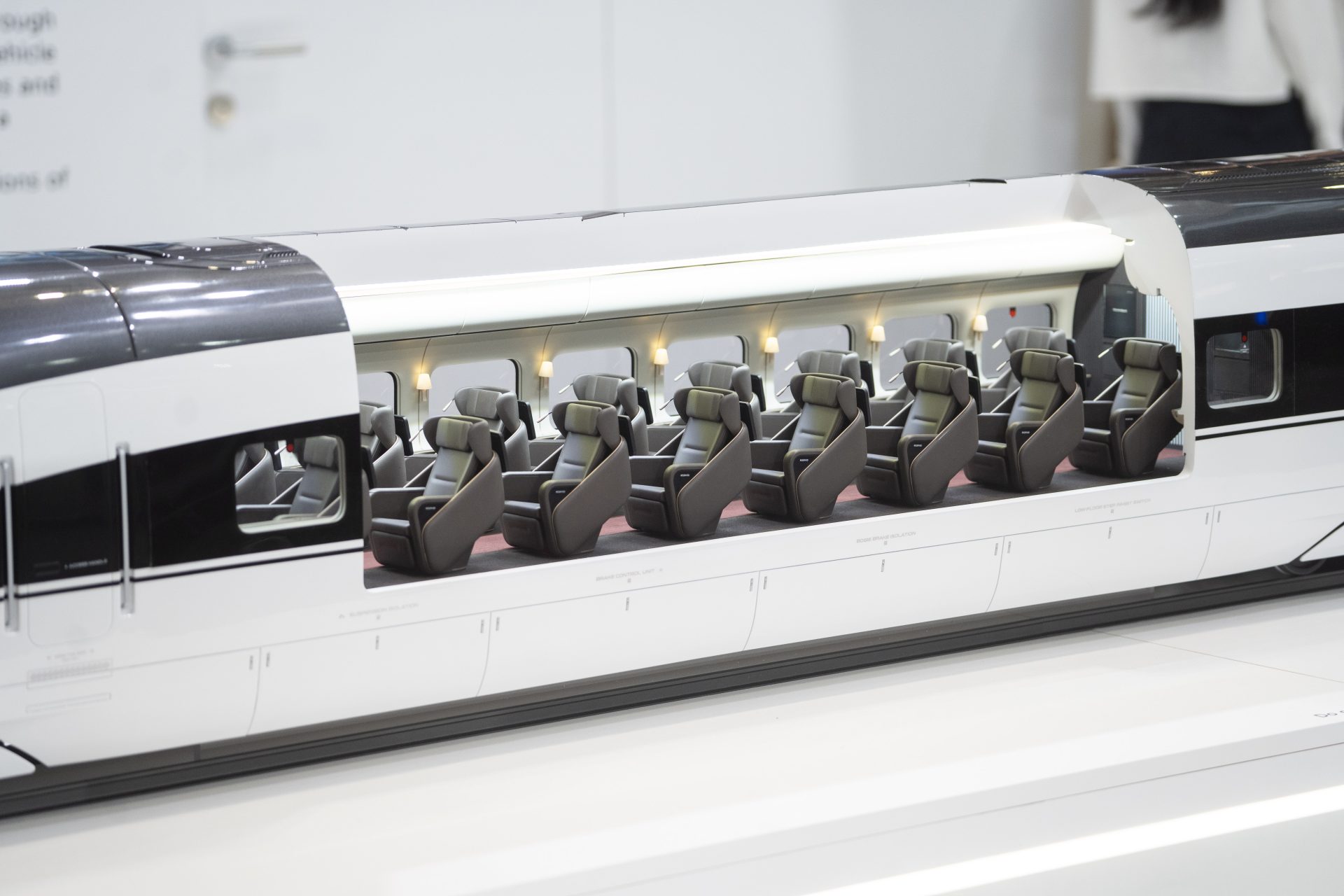
The cabin design prioritizes passenger comfort and the efficient use of space. It blends Korean aesthetics, characterized by understated elegance and fluid curves, with ergonomic engineering tailored to passenger posture and movement. The cabin’s interior layout was also reconfigured to expand legroom and improve luggage rack functionality. This approach reflects careful consideration of not only high-speed running performance but also the passenger experience from boarding to transit.
This next-generation high-speed train concept builds upon Hyundai Rotem’s extensive experience developing high-speed rail technology. Building on its experience manufacturing KTX high-speed trains, Hyundai Rotem secured proprietary high-speed vehicle technologies through the G7 national R&D project and the KTX-Sancheon. The company then further developed distributed-traction high-speed train technology with the HEMU-430X. After commercializing the EMU-260 (KTX-Eum) and the EMU-320 (KTX-Cheongryong), Hyundai Rotem completed core technology development for the 370 km/h-class EMU-370 in 2025.
In developing the EMU-370, in particular, Hyundai Rotem optimized the overall vehicle profile, including the nose, underbody, and roof, to reduce aerodynamic drag during high-speed operation. As a result, the drag coefficient was reduced by approximately 12.3% compared to that of the KTX-Cheongryong. This example demonstrates that optimizing a vehicle’s profile and structure is becoming increasingly important as high-speed rail vehicle technology advances.

During “Beyond Speed, Designing Better Journeys,” its presentation session on the vision for high-speed rail vehicles, Hyundai Rotem also emphasized this direction in technology development. This conveyed the message that in addition to enhancing speed and performance, it is essential to deliver reliable vehicles across diverse operating environments while providing passengers with a better travel experience. The technologies and experience accumulated in Korea’s rail environment, which features diverse operating conditions such as extreme heat, severe cold, and long mountain tunnels, serve as the foundation of Hyundai Rotem’s competitiveness in overseas markets as well. In fact, Hyundai Rotem is optimizing its vehicles for the local climate and operating environment in the Uzbekistan high-speed rail project.
The exhibition also featured diverse interactive content that allowed visitors to directly explore the design and spatial layout of the next-generation high-speed train. In the High-Speed Solution Zone, a scale model showcased the exterior of the high-speed train as well as the interiors of its VIP, Business, and Standard cabins. Visitors embarked on a virtual journey from Berlin Central Station to Korea via VR content and vividly experienced the high-speed train’s sense of speed inside a four-sided LED media theater.
In the outdoor display area, a full-scale EMU-320 (KTX-Cheongryong) train, which is currently operating in Korea, was also exhibited. Visitors stepped aboard the vehicle to tour the Standard and First Class cabins and see firsthand how Hyundai Rotem’s high-speed rail vehicle technologies are implemented in an actual train.
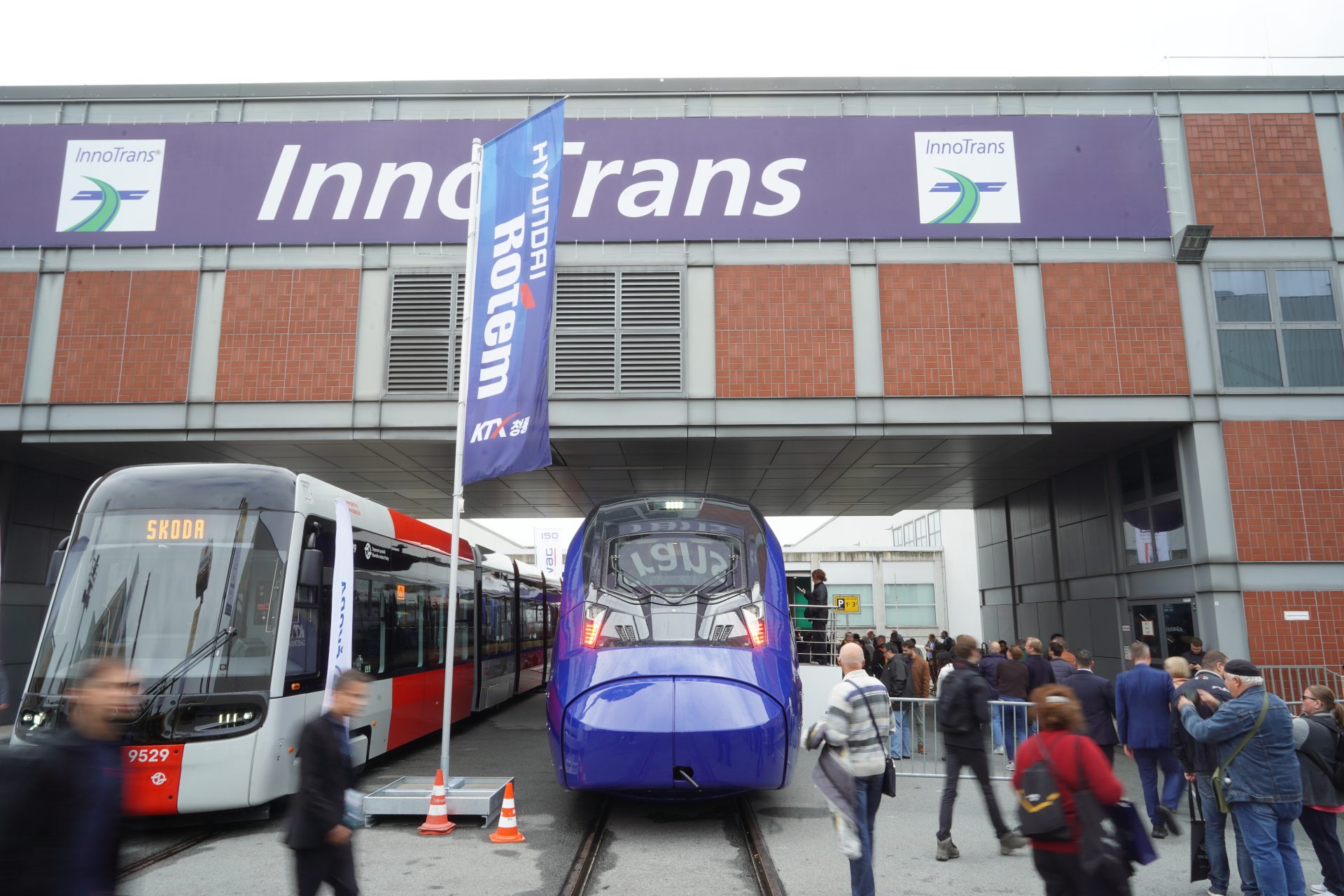
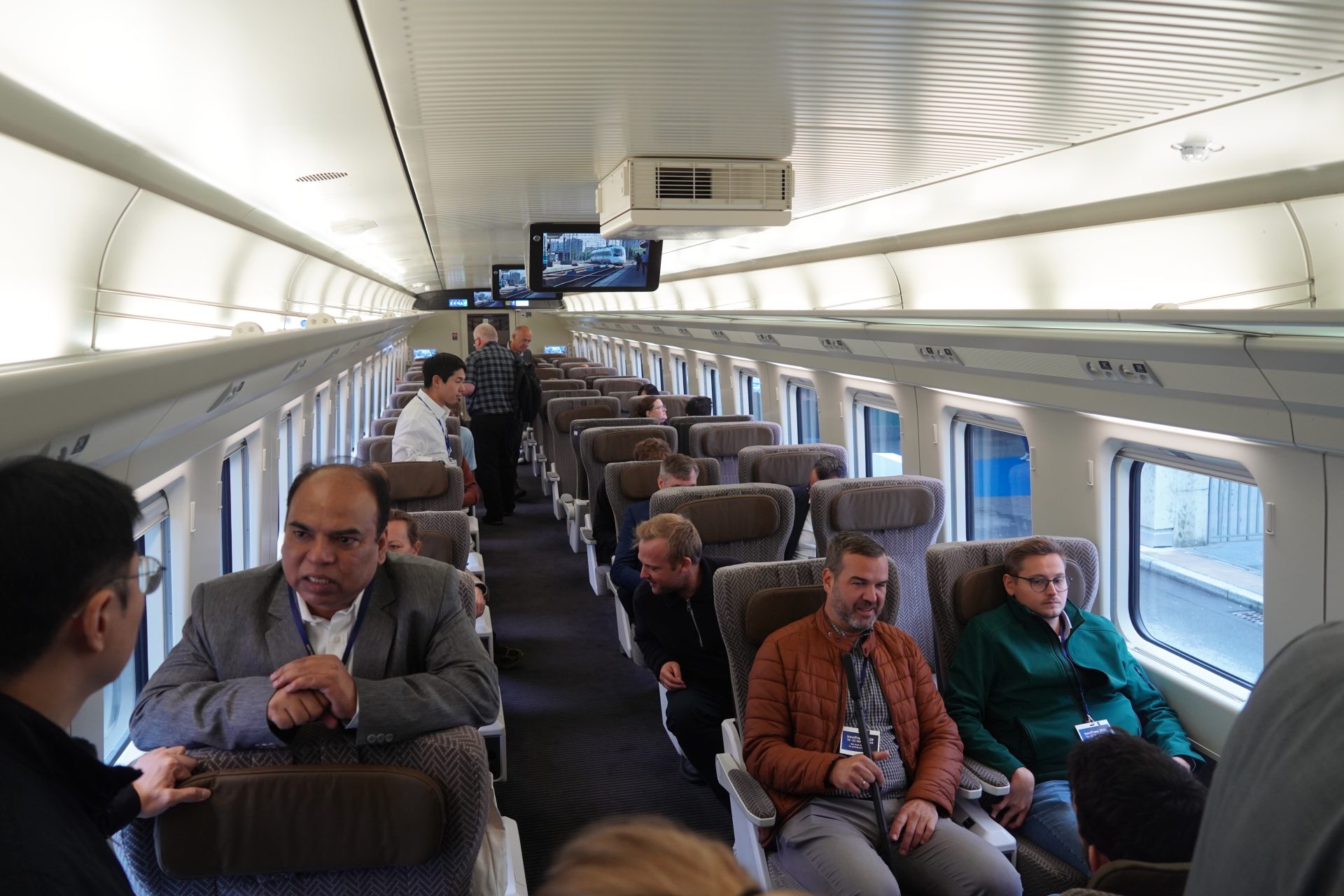
From the EMU-320 currently in operation to the next-generation concept model embodying the future of high-speed rail, the exhibition demonstrated both the achievements of Hyundai Rotem’s accumulated high-speed rail vehicle technology and its future development direction.
From Hydrogen Electric Trams to Hydrogen Locomotives: The Expanding Potential of Hydrogen Rail
At InnoTrans 2024, Hyundai Rotem unveiled a full-scale hydrogen electric tram and presented a blueprint for hydrogen mobility solutions encompassing hydrogen production, supply, and utilization. Two years later, at InnoTrans 2026, the company presented further advances in hydrogen rail technology and tangible commercial achievements. By expanding the technologies it has advanced around its hydrogen electric tram to a wide range of rail vehicles, Hyundai Rotem is broadening the applicability of hydrogen rail.
This shift was also highlighted during “Connecting Tomorrow with Hydrogen,” a presentation session on the vision for hydrogen mobility held at the exhibition. In particular, following technology development and demonstration, the hydrogen electric tram is now being implemented in actual urban railway projects. Hyundai Rotem’s hydrogen electric trams are scheduled for deployment on Ulsan Metro Line 1, the Taehwagang Station–Jangsaengpo Line, and Daejeon Metro Line 2. Since the trams generate electricity from onboard hydrogen fuel cells, they can operate without overhead contact wires, offering the advantage of reducing the burden of catenary lines and related power supply infrastructure in urban areas.
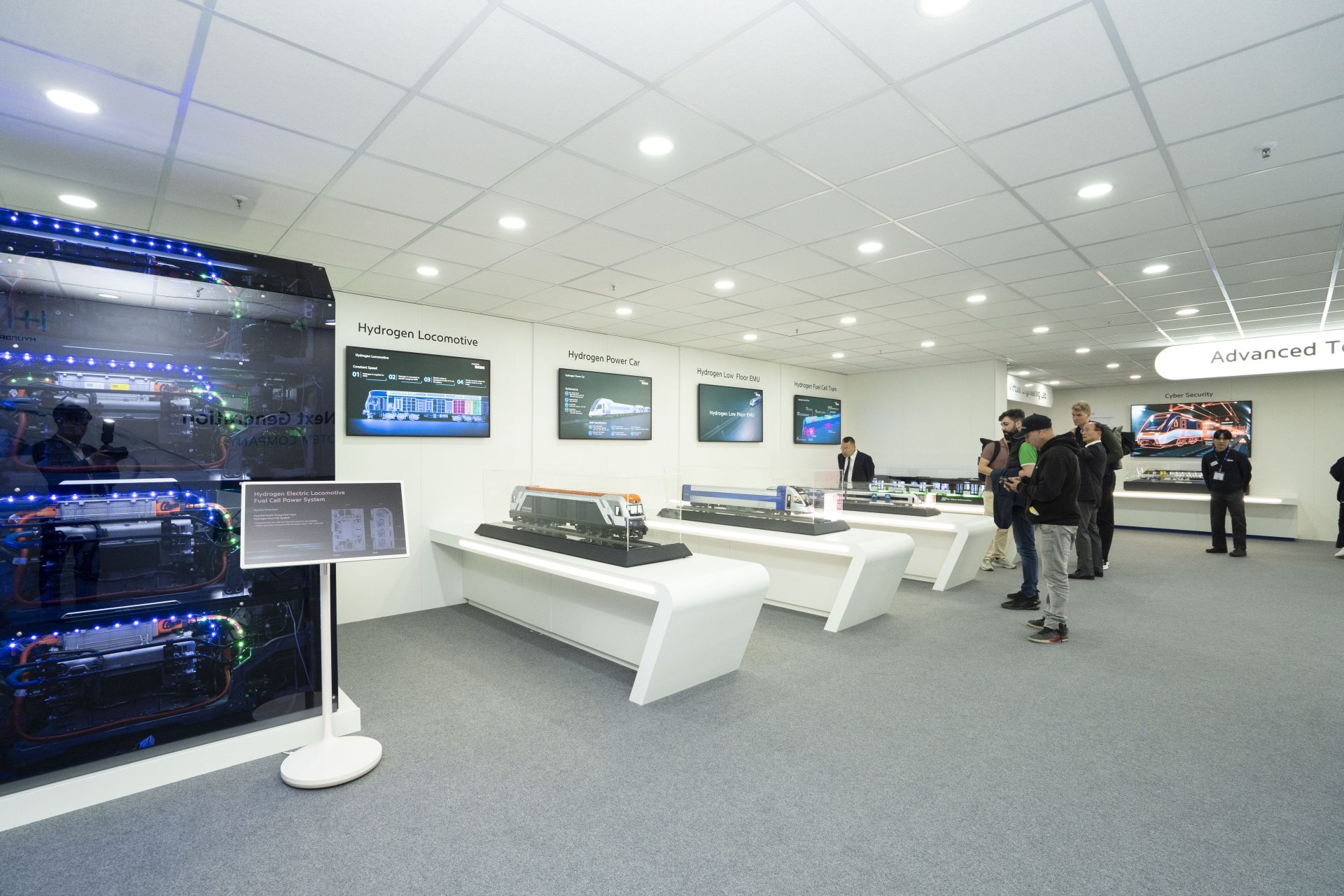
The technologies and expertise gained during the development of the hydrogen electric tram are being extended to rail vehicles for diverse operational purposes. Specifically, the scope of application is expanding from trams for urban transit to multiple units for metropolitan and regional lines, power cars for long-distance passenger service, and locomotives for freight transport. Particularly on routes where electrification is difficult, hydrogen rail vehicles are gaining attention as a decarbonization alternative to replace conventional diesel vehicles.
The low-floor hydrogen electric multiple unit, which is currently under development for metropolitan and regional lines, targets a maximum design speed of 110 km/h. Hyundai Rotem is developing the vehicle with a low-floor structure for convenient passenger boarding and alighting, along with a distributed-traction system, to meet diverse transport demands. Designed to be placed at both ends of a train, the hydrogen electric power car for long-distance passenger service is being developed for 220 km/h-class operation.
In the freight transport sector, core technologies for hydrogen electric locomotives are being developed to replace conventional diesel locomotives. Hyundai Rotem is developing technologies that support various power outputs according to operational purposes and performance requirements. In particular, the 3 MW-class hydrogen electric locomotive is targeted for heavy freight transport requiring high power.

A key element for securing the power output required across diverse vehicles is the Fuel Cell Power System (FCPS). Building on Hyundai Motor Company’s next-generation fuel cell technology, Hyundai Rotem is developing technologies that combine and centrally control fuel cell modules according to each vehicle’s required output. The 3 MW-class hydrogen electric locomotive will feature a configuration that integrates and controls six FCPS units. At the exhibition, the company also showcased the corresponding fuel cell modules, highlighting the core propulsion technology of its hydrogen rail vehicles.
Hydrogen rail vehicles employ a hybrid propulsion system that uses both fuel cells and batteries. Electricity generated by the fuel cells is used to drive the vehicle, while the batteries provide supplemental power in situations requiring high instantaneous output, such as during acceleration or on uphill gradients. Additionally, storing energy recovered during braking in the batteries and reusing it enhances overall energy efficiency.
Expanding hydrogen rail requires not only vehicle technology but also a reliable hydrogen supply environment. Hydrogen production, storage, transportation, and refueling infrastructure must be seamlessly integrated with vehicle operations. In conjunction with Hyundai Motor Group’s hydrogen technology capabilities, Hyundai Rotem is presenting an integrated hydrogen mobility solution encompassing everything from rail vehicles to energy supply infrastructure.
After presenting its blueprint for hydrogen mobility in 2024, Hyundai Rotem further refined its vision at InnoTrans 2026 through actual urban railway projects and diverse vehicle development plans. The company continues to develop hydrogen rail solutions suited to various operating environments and transport purposes, expanding the scope of application from hydrogen electric trams to passenger and freight transport.
RailLifeCare: An AI Platform Connecting the Full Lifecycle of Rail Vehicles
Once manufactured, rail vehicles remain in service for decades. Following design, manufacturing, and testing, they are placed into service, after which they undergo continuous inspection and maintenance throughout their operation. Throughout this process, vast amounts of data are collected, including design drawings, quality records, operational data, and fault and maintenance histories. However, challenges remain in interconnecting and utilizing the data generated at each stage.
Unveiled for the first time by Hyundai Rotem at InnoTrans 2026, RailLifeCare is an agentic AI platform that connects this data to comprehensively manage the full lifecycle of rail vehicles. Using data accumulated from design and manufacturing to operation and maintenance, AI analyzes conditions, predicts potential issues, and recommends necessary actions. Once users review and execute these actions, the results are fed back as data and utilized for subsequent decision-making.

During the design and manufacturing stages, AI reduces repetitive tasks and streamlines the development process. It automates the review of customer requirements and design changes, as well as the drafting and translation of technical documents, while ensuring that design modifications are consistently reflected across related components and production processes. In fact, in Australia’s Queensland Train Manufacturing Program (QTMP) project, AI-driven design change tracking reduced administrative work by approximately 1,600 hours per year and minimized manual errors. Furthermore, digital twin technology allows vehicles and production processes to be modeled in a virtual space, enabling the validation of designs and processes before actual manufacturing begins.
Once a vehicle enters service, operational data is used to enhance operating efficiency and vehicle health management. By comparing operating conditions predicted through a digital twin with actual operational data, the system identifies anomalies and forecasts energy consumption to derive efficient driving strategies. High-speed train trials applying this technology to Smart Cruise, an optimal driving mode, demonstrated energy savings of approximately 10%.
During the maintenance stage, AI analyzes the root causes of faults and supports maintenance workflows. At the exhibition, visitors were able to test the AI-enhanced Maintenance Management Information System+ (MMIS+) firsthand on a tablet. When a train driver reports a fault by voice, AI classifies the fault type, searches relevant manuals and past cases, and recommends appropriate corrective actions. Authorized personnel then review the relevant information before deciding on the final action.
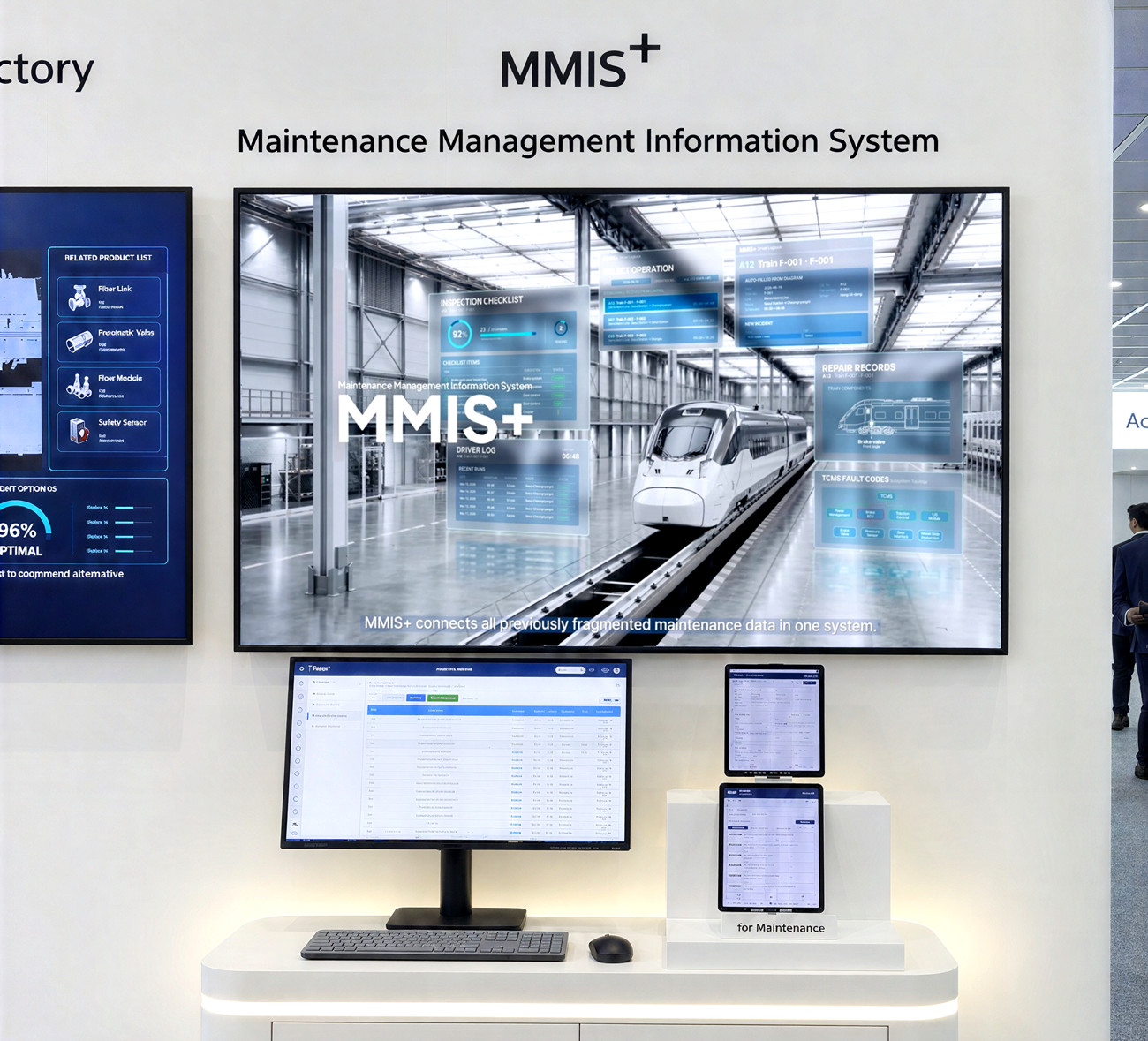
Such AI-based maintenance technologies are also being used in actual overseas rail projects. The AI Helpdesk applied to Australia’s New Intercity Fleet (NIF) project reduced the time needed to search for troubleshooting procedures by over 90%, while the automated fault classification system cut classification time by more than 60%. In addition, Hyundai Rotem is developing Condition-Based Maintenance (CBM) technologies that predict the remaining useful life of batteries and hydrogen fuel cells and remotely diagnose pantograph contact strip wear via video.
A key feature of RailLifeCare is that data accumulated at each stage can be reused in the next stage. Vehicle conditions and fault histories identified during operation and maintenance can be used to improve future vehicle designs and validate performance. The platform aims to enhance efficiency and reliability across the full lifecycle of the vehicle through a closed-loop system, in which data flowing from design to operation and maintenance feeds back into design.
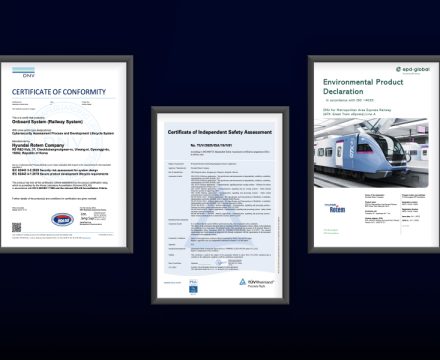
Meanwhile, as connectivity between rail vehicles and operating systems expands, the importance of cybersecurity also grows. Hyundai Rotem was the first company in the Korean rail industry to obtain certification for IEC 62443, the international cybersecurity standard for industrial control systems. At the exhibition, the company showcased both this certification and the cybersecurity technologies applied to Australia’s QTMP project. This is part of Hyundai Rotem’s efforts to build a safe and reliable operating environment in step with the advancement of AI- and data-based rail systems.
A Future Smart Hydrogen City Envisioned with AI Traffic Control and Autonomous Trams
The role of AI extends beyond rail vehicle design and maintenance. At InnoTrans 2026, Hyundai Rotem also presented a future operating environment in which AI supports train operations and traffic control and further connects with urban transportation and energy systems.
A prime example was the autonomous tram diorama (measuring 2.6 m wide by 1.6 m deep) displayed at the center of the AI Solution Zone. Under the theme “Hydrogen in Motion, Intelligence in Control,” the diorama used scale models and video to depict a day in a smart hydrogen city where an AI traffic control system and autonomous trams operate in unison.
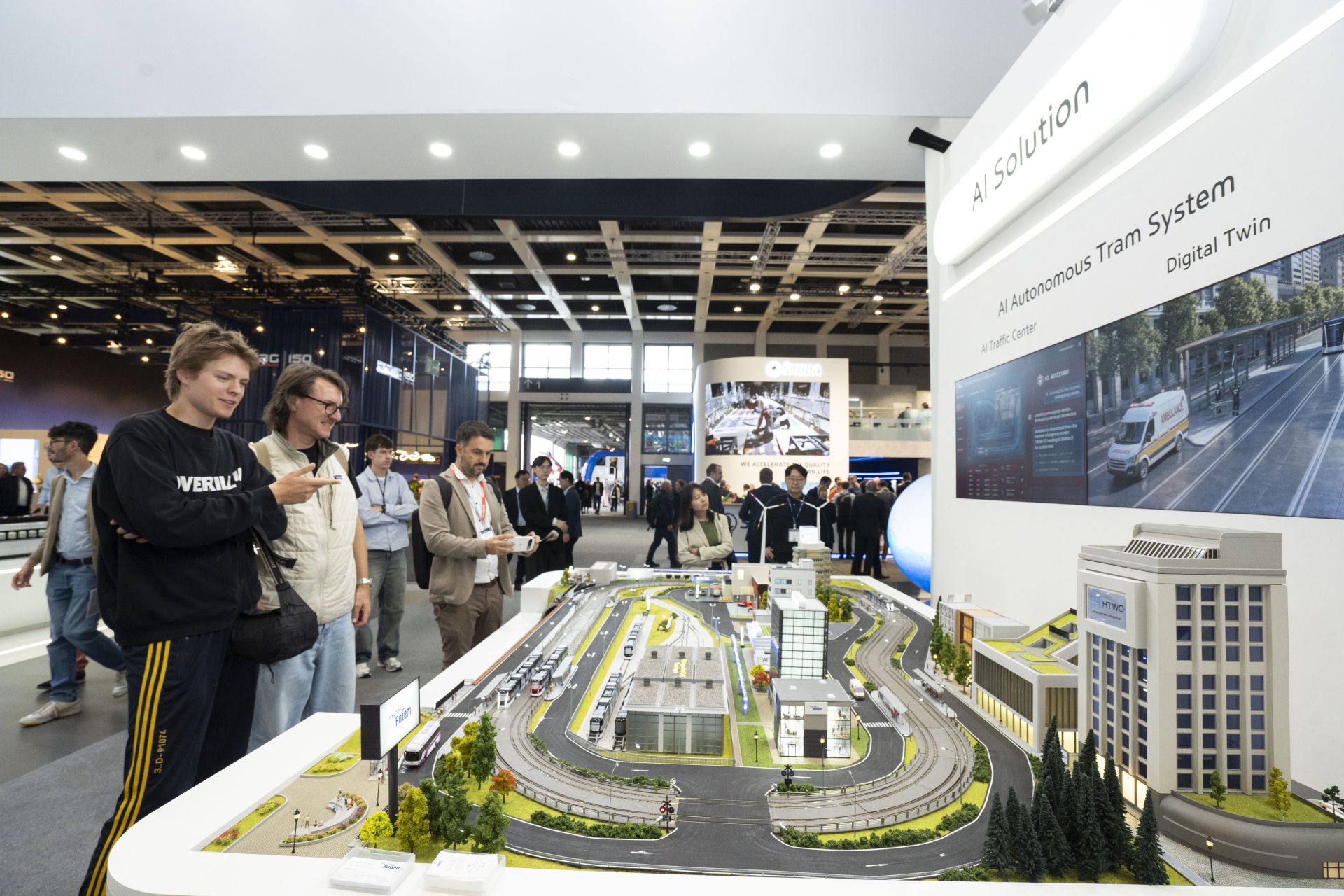
The future operating scenario depicted in the diorama is based on the autonomous driving technology that Hyundai Rotem has been developing. In 2026, Hyundai Rotem completed the development of an Advanced Driver Assistance System (ADAS) for rail vehicles. This technology uses LiDAR sensors and AI-based collision avoidance algorithms to recognize obstacles ahead of the vehicle, such as people and structures, and detect hazardous situations. Since trams run on roads shared by automobiles, pedestrians, and bicycles, this hazard detection technology is particularly crucial. Building on this foundation, Hyundai Rotem plans to further advance autonomous driving technologies for its hydrogen electric trams.
In the diorama, a day in the smart hydrogen city begins when a controller logs in to the AI traffic control system. The AI agent analyzes and briefs the controller on the previous day’s operational performance and special conditions for the day, then proposes an optimal operating schedule based on this analysis. In this scenario, the proposed schedule is first simulated and reviewed in a digital twin environment before being incorporated into the actual operating plan upon the controller’s final approval.
Even after train operations begin, AI continues to analyze real-time data to support traffic control tasks. When train delays are anticipated due to increased passenger demand, the AI proposes deploying additional trains and adjusts operations so that the newly dispatched trains maintain appropriate headways with preceding and following vehicles. This illustrates an operational framework in which AI analyzes operating conditions to present alternatives, a digital twin pre-validates them, and humans make the final decision.

The diorama also demonstrated responses to unexpected emergencies. For example, if a passenger collapses aboard an unmanned tram, onboard AI CCTV detects the abnormal situation and notifies the traffic control system. Based on the transmitted information, the control center executes the necessary response while simultaneously adjusting the operations of nearby trains. This future operating scenario illustrates how AI-based detection technology and the traffic control system are linked to support passenger safety.
The diorama’s perspective expands beyond train operations to encompass the entire city. It envisions using renewable energy generated from solar and wind power to produce green hydrogen at a water electrolysis plant. This hydrogen is then supplied as an energy source for modes of transport such as trams, buses, passenger cars, and hydrogen trains. Robots are deployed to hazardous work sites, while the AI control center monitors the city’s traffic and energy flows in an integrated manner.
At the exhibition, Hyundai Rotem introduced this concept in connection with the Saemangeum AI Hydrogen City spearheaded by Hyundai Motor Group. In doing so, the company presented a vision of a future city where hydrogen-powered modes of transport and AI-based operating systems are seamlessly connected.
Starting with technologies that enable rail vehicles to detect hazards independently, the diorama illustrated a future where AI supports train operations and links them with the city’s transportation and energy systems. The exhibition showcased the potential of AI to expand beyond individual vehicle intelligence into overall rail operations and urban mobility.
While the technologies showcased by Hyundai Rotem at InnoTrans 2026 span diverse fields such as high-speed rail, hydrogen mobility, and AI, they all point in a single direction. Together, they encompass next-generation high-speed rail vehicle technologies for faster and more comfortable travel, eco-friendly propulsion systems adaptable to diverse operating environments, and AI-based solutions covering everything from rail vehicle design to operation and maintenance.
Building on Hyundai Rotem’s accumulated capabilities in developing rail vehicles, the exhibition showcased technologies that go beyond vehicle manufacturing to enhance the efficiency and sustainability of rail systems as a whole. Through field-proven technologies and new initiatives for the future, Hyundai Rotem continues to realize mobility solutions tailored to the specific rail environments and customer needs of countries worldwide.